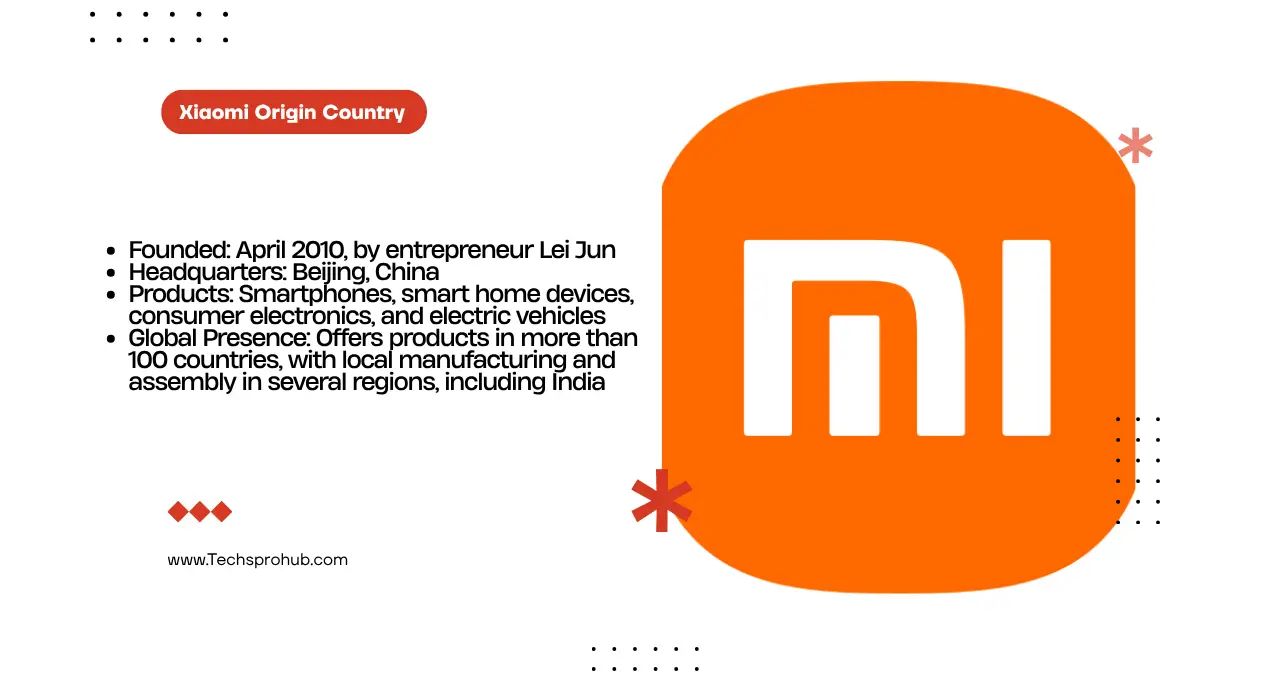


The country where Xiaomi originated is China, the Xiaomi origin country. Xiaomi Corporation, founded in April 2010 and headquartered in Beijing by a number of co-founders, including Lei Jun (Chairman and Chief Executive Officer), is a company. It has been successfully incorporated into the Main Board of the Hong Kong Stock Exchange with a stock code: 1810. HK.
If you’ve been wondering, ‘where is Xiaomi from?’, now you know: Xiaomi is a Chinese company based in China.
But a little twist you may want to take note of: Xiaomi mobiles are sold in lots of countries along with India, so “from where Xiaomi comes” and “from where your particular Xiaomi phone was made” are not always equal. We will look into it below.
Table of Contents
Xiaomi at a Glance
| Full name | Xiaomi Corporation (小米集团) |
| Country of origin | China |
| Founded | April 2010 |
| Headquarters | Haidian District, Beijing, China |
| Founder & CEO | Lei Jun |
| Listed on | Hong Kong Stock Exchange (HKEX: 1810) |
| Main products | Smartphones, smart home devices, electric vehicles |
Xiaomi Origin Country?
Xiaomi is a Chinese company. It was established in Beijing in April 2010 by Lei Jun with seven co-founders. Its head office is still located in Beijing.
This gets confused sometimes, as Xiaomi is a high-volume seller in India, Europe, Southeast Asia, and Latin America, has manufacturing units in several countries, including India, and has regional subsidiaries. The parent company, its management, and its corporate registration are Chinese, though.
Is Xiaomi a Chinese Company?
Yes, without caveats. Continually referred to as a Chinese multinational technology company by business references, reference sources, and its own investor relations. Xiaomi is a publicly listed firm, not a state-owned enterprise. Its stocks are listed on the Hong Kong Stock Exchange, with the majority held by public and institutional investors such as BlackRock and Vanguard. Being a Chinese company is not the same as being state-controlled, and that’s what Xiaomi is.
Who Owns Xiaomi?
Ownership and control are two different questions here, and the answers to these are as follows:
On the financial side, Xiaomi is the most widely held. Around 50% of the stock is held by Retail Public Investors, and the remaining 50% is held by institutions. BlackRock and Vanguard will be the largest owners, with less than a 10% shareholding.
Strategically, it is founder-controlled. Lei Jun owns about 23-24% of outstanding shares, but through a dual-class share structure with super-voting Class A shares owns around 60% voting rights, roughly 2/3, in recent filings. Lin Bin, one of the founders, owns approximately 8-9%.
Practically, no external investor can vote against the founder. He has veto rights on strategy, which has allowed Xiaomi to make big, founder-led investments, such as in the EV industry.
Main shareholders
| Holder | Approx. stake | Note |
|---|---|---|
| Lei Jun (founder, CEO) | ~23–24% | Controls ~60%+ of voting rights |
| Lin Bin (co-founder) | ~8–9% | Vice Chairman |
| BlackRock | ~4–5% | Institutional |
| Vanguard | ~2–3% | Institutional |
| Public & retail investors | Remainder | Nearly half in some analyses |
Who Founded Xiaomi?
Lei Jun co-founded Xiaomi in 2010 with seven colleagues. As a computer engineer and serial entrepreneur, he was formerly president of Kingsoft, a Chinese software organization. He is currently Chairman and CEO and is directly involved in the majority of the Company’s releases.
Lin Bin, one of the original co-founders, subsequently became Vice Chairman.
Is Xiaomi Banned in the United States?
No. This one is based on a true story that is well known.
In January 2021, the US Department of Defense listed Xiaomi among sixteen “Communist Chinese Military Companies,” which led to a prohibition on investment by US persons. Xiaomi filed a lawsuit against the US government claiming that the listing was false. In May 2021, it was vacated by a federal court, and Xiaomi was officially delisted. Subsequent US sanction programs did not re-list it.
Xiaomi phones do not exist; they are rarely sold in the United States, but that is a commercial choice and not a ban. Xiaomi chose instead to target markets where they could compete on the price front, namely India, Southeast Asia, Europe, and Latin America.
Is Xiaomi Safe to Use?
Yes, for most users, with 2 caveats that would be good to know before you buy.
Ads and bloatware. This is by far the most common honest gripe. The software has generally been known to show system-level ads in its own apps (such as Themes, Security, and File Manager), on budget and mid-range devices in particular. Some cannot be uninstalled, and others reappear after updates. These can be disabled in settings, but you need to find them first.
There is a logic here: Xiaomi ensures its hardware margins are extremely tight (it has publicly stated that it will not make more than 5% profit on its hardware) so it can make its profits from services and advertising instead. The low price and the paid-for advertising are simply two sides of the same coin.
Privacy inquiry. Xiaomi has been subject to occasional privacy inquiries, as most large phone manufacturers have. In late 2025, India pressed Xiaomi and other brands to stop preinstalling a government-required app; this was acquiesced to after public opposition. In 2026, Xiaomi’s Vietnamese distributor was penalized for laws regarding consumer protection, specifically advertising permission and endorsement reporting.
This is not specific to Xiaomi, but just fair context when you are comparing brands.
What Does Xiaomi Actually Make?
Xiaomi is far broader than a phone company:
- Smartphones – Redmi (budget and mid-range), Xiaomi (Flagship), and foldables. Always positioned in the top three in worldwide shipments.
- Smart home and lifestyle TVs, wearables, earbuds, routers, robot vacuums, air purifiers, kitchen appliances, and hundreds of other connected devices
- Electric vehicles including the SU7 sedan and YU7 SUV, introduced by Xiaomi Auto
- Software Brief: HyperOS, the multi-device OS that replaced MIUI across phones, tablets, TVs, and cars
This was a plan Xiaomi defined as “Human × Car × Home” — bringing affordable, well-specced hardware into a massive installed base across phones, homes, and now cars, then monetizing high-margin internet services on top of it.
Frequently Asked Questions
Which country is Xiaomi from?
China. Xiaomi was founded in Beijing in April 2010 and is still headquartered in the Haidian District of Beijing.
Is Xiaomi a Chinese company?
Yes. It is a Chinese multinational technology company, publicly listed on the Hong Kong Stock Exchange under code 1810.
Who owns Xiaomi?
It is publicly listed, so ownership is spread across many shareholders. Founder Lei Jun is the largest individual holder at roughly 23–24%, and through super-voting shares he controls around 60% of voting rights.
Is Xiaomi owned by the Chinese government?
No. Xiaomi is a privately founded, publicly traded company. It is not a state-owned enterprise, and its largest shareholder is its founder.
Who is the CEO of Xiaomi?
Lei Jun, who founded the company in 2010 and serves as both Chairman and CEO.
Is Xiaomi banned in the US?
No. It was briefly placed on a US Department of Defense list in January 2021, but a federal court vacated the designation in May 2021 and Xiaomi was removed. Its phones are rarely sold in the US by choice, not by prohibition.
Is Xiaomi safe to use?
For most users, yes. The main practical complaints are system-level ads and preinstalled apps in its software, which subsidise the low hardware prices. Most ads can be disabled in settings.
Is Xiaomi the same as Redmi?
Redmi is Xiaomi’s budget and mid-range sub-brand. Both are owned and made by Xiaomi Corporation.
The Bottom Line
Given the information that we have, Xiaomi is a Chinese company; it was founded and still is.
Headquartered in Beijing, traded on the Hong Kong stock exchange, and effectively controlled by the founder rather than the Chinese government or external investors.
I’m not saying whether that matters to you one way or the other, just that I think it makes a difference where it’s registered. The commercial compromise with Xiaomi is one which the Company makes for itself; outrageous hardware for the cost is gained at the expense of displaying advertising in the software.
Curious where other major brands come from? See our guides to which country Samsung is from and where the iPhone is made.