

Summarize this article with
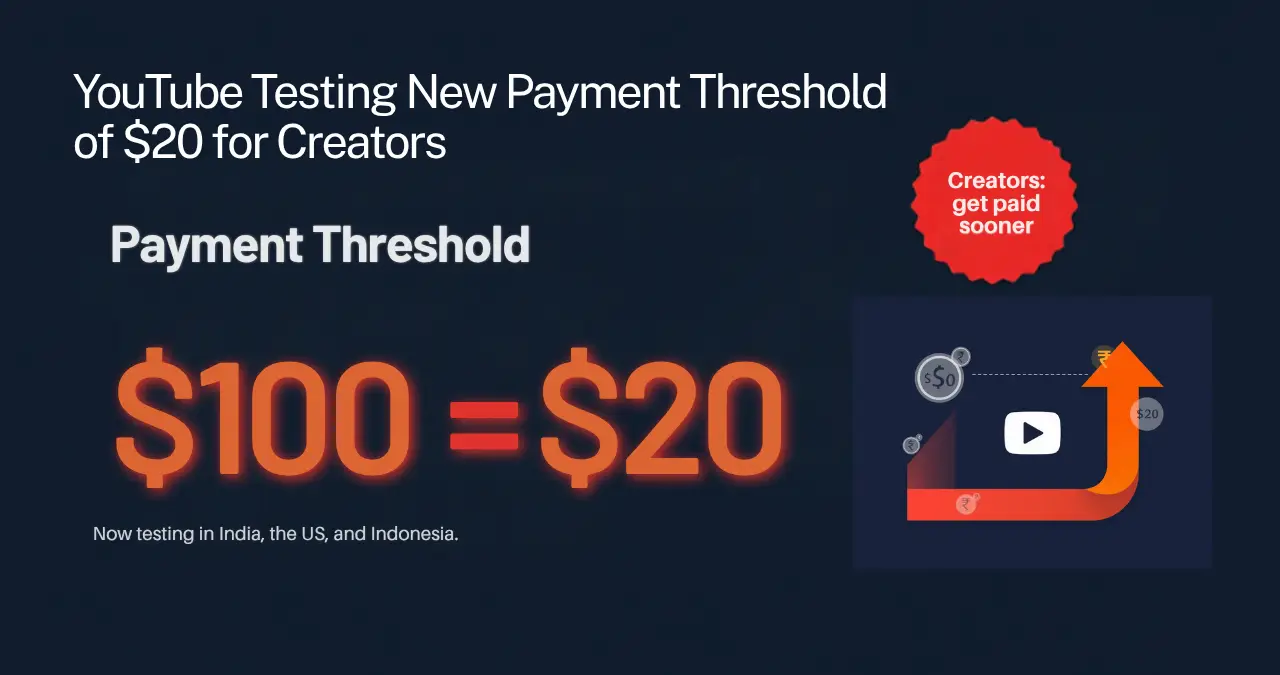
YouTube is testing a YouTube $20 payment threshold for a random group of creators in India, the US and Indonesia. Normally, your AdSense for YouTube balance has to hit $100 before Google pays you. In this experiment, it’s $20 (or the local-currency equivalent). Here’s who’s in it, how the payout cycle works now, and what I’d check if you got the notification.
Table of Contents
What Is the YouTube $20 Payment Threshold Test?
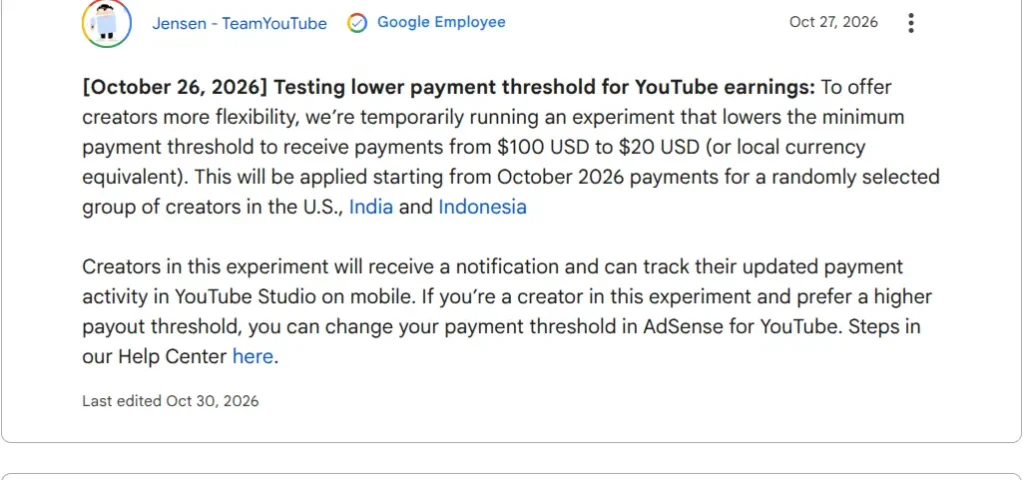
It’s a temporary YouTube experiment that cuts the minimum payout from $100 to $20 (or the local-currency equivalent) for a randomly selected group of creators in the US, India and Indonesia. It applies to October 2026 payments. Creators in the test get a notification, and anyone who’d rather keep a higher threshold can raise it in AdSense for YouTube.
YouTube listed the change on its official test features and experiments thread, and Social Media Today and Tubefilter reported it on 27 and 28 October 2026. YouTube’s stated reason is short: it wants to give creators “more flexibility.” It hasn’t said how long the test will run.
| Detail | Standard AdSense for YouTube | Creators in the test |
|---|---|---|
| Minimum payout | $100 (or local equivalent) | $20 (or local equivalent) |
| Countries | All | US, India, Indonesia |
| Who gets it | Everyone by default | A randomly selected group |
| Starts | — | October 2026 payments |
| How you know | — | A notification from YouTube |
| Can you change it? | Yes, you can raise it | Yes, you can raise it back up |
Who Gets the Lower Payout in India
You can’t apply for this one. YouTube picked creators at random, so two channels of the same size in the same city can see different thresholds. The test covers creators who are already earning through the YouTube Partner Program and get paid through AdSense for YouTube. According to YouTube, creators who’ve been added will get a notification and can follow their payment activity in YouTube Studio on mobile.
Nothing in YouTube’s note changes the rules for joining the Partner Program. Our guide to the YouTube monetisation rules covers those. The test only changes how much you need in your balance before a payout goes out, not how you qualify to earn.
How YouTube’s Payment Cycle Works With a Lower Threshold
The threshold is only one step in a monthly cycle. A lower number doesn’t make payments arrive faster within the month. It decides whether your balance qualifies for that month’s payment run at all. Google’s AdSense help pages lay out the timeline like this:
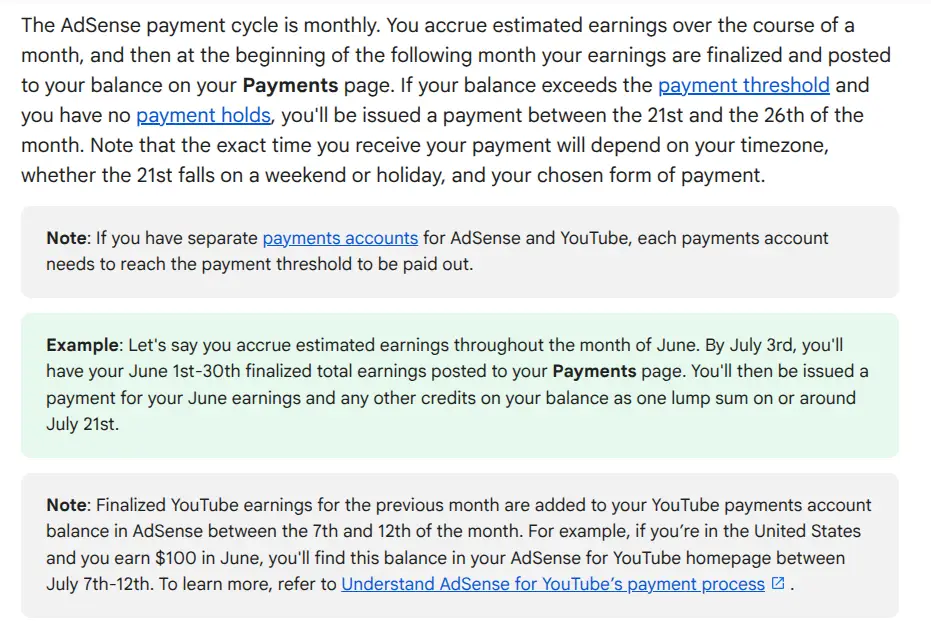
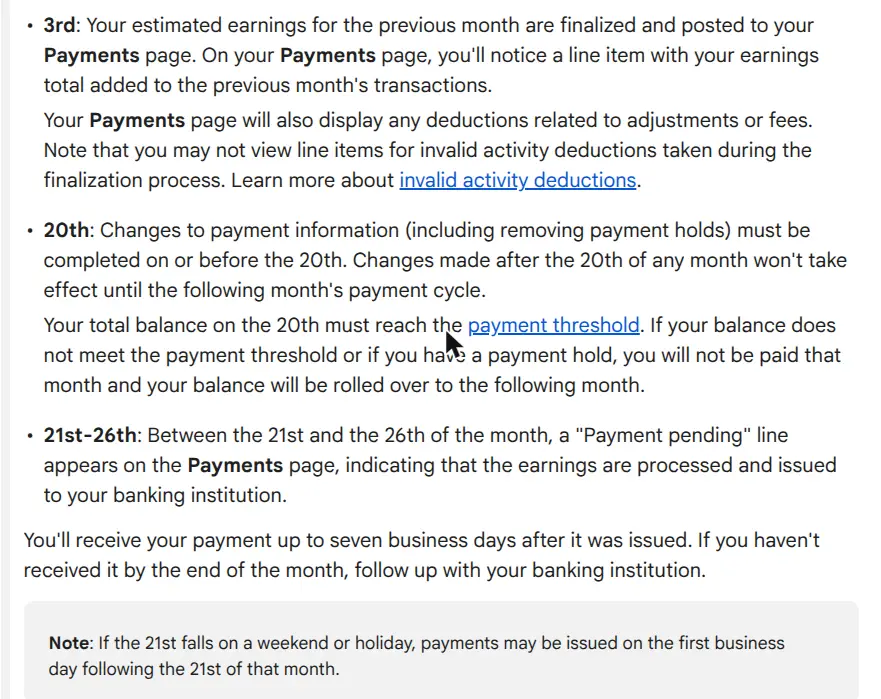
- Around the 3rd: last month’s earnings are settled.
- Between the 7th and 12th: settled YouTube earnings land in your YouTube payments account.
- On the 20th: your balance has to meet the payment threshold.
- Between the 21st and 26th: the payment is issued if you qualified and have no holds on the account.
If you’re short of the threshold on the 20th, nothing is lost. The balance simply rolls over to the next month and keeps building until it crosses the line.
Why a $20 Threshold Matters for Small Indian Channels
For a big channel, $100 comes in fast, so the test changes very little. The difference shows up for new and small creators. If your channel earns about $25 a month, you’d normally wait four months to see your first payment. With a $20 threshold, you could be paid in month one.
That faster cash flow is useful when you’re putting money back into the channel: a better mic, a light, or a few of the tools for YouTube creators. It also makes the first payment feel real much sooner, which matters for motivation in a creator’s first year. Tubefilter noted that the three test markets include two where the local currency is weak against the dollar, which makes $100 a much bigger target in rupee terms.
Should You Keep $20 or Raise Your Threshold?
Most small creators will be happy with $20. Still, there are good reasons to go higher. Each international wire can come with charges from your bank, so lots of tiny transfers may cost more in fees than a few larger ones. More frequent foreign remittances also mean more entries to reconcile at tax time.
Google’s help pages confirm you can set a payment threshold higher than the default in your payment settings. I’d check what your bank charges for an inward foreign remittance before deciding. If the fee eats a noticeable chunk of a $20 payment, raising the threshold to $50 or $100 is the smarter move.
How to Check Whether You’re in the Experiment
YouTube hasn’t published a separate opt-in page, so here’s what I’d do:
- Look for the notification. YouTube says creators in the test will receive one.
- Open YouTube Studio on your phone. YouTube says test creators can track their updated payment activity there.
- Check AdSense for YouTube. Your payment settings show the threshold that applies to your YouTube payments account. Each payments account has its own threshold, so your website AdSense setting won’t tell you anything about YouTube.
Seeing $100 there? You’re not in the test, at least for now. YouTube often widens experiments that work, but it hasn’t promised anything here.
Things That Can Still Hold Up a Payment
A lower threshold won’t help if something else blocks the payout. AdSense only pays when there are no holds on your account. Google’s help pages list separate, smaller thresholds that trigger other steps, such as adding a payment method once your balance reaches $10 and verifying your address at $10. I’d make sure these are done early, because a missing bank detail or an unverified address can stall a payment even after you cross $20.

Quick Questions About the YouTube Payout Change
Is the $20 threshold permanent?
No. YouTube calls it a temporary experiment and hasn’t given an end date.
Can I ask YouTube to add my channel?
No. Creators were picked at random, and YouTube hasn’t offered a way to join.
Does the test change how much I earn?
No. It changes when money is paid out, not how much your videos earn.
The Bottom Line for Indian Creators
The YouTube $20 payment threshold is a small change with a real upside for new channels: money in your bank sooner, instead of months of waiting to reach $100. It’s random, temporary and limited to three countries, so don’t plan around it unless you’ve had the notification. If you have, I’d check your bank’s remittance fees and pick the threshold that actually leaves you with more money. For more creator-side news, browse our Apps section. Are you in the test? Tell us in the comments.