

Summarize this article with
Learning how to handle your own investment portfolio isn’t focused on scrutinizing the market constantly or reacting to the news headlines. It’s focused on the process: the correct asset allocation, the discipline of diversification, an understanding of costs, and the system to keep improving over time. In my view, the people who get in trouble with investing are not those who are short of knowledge, but those who are short of a process. Here’s the process, broken into achievable steps.
Table of Contents
Start With Your Goals and Time Horizon
Identify the purpose of the money before choosing one investment. Is it to create a future lifetime of wealth, save for a house, put into a pension, or fund your child’s education? This decision paves the road for everything else.
Your time horizon is just as important as your goal. Money needed in 3 years should be invested differently than in 20 years. If you’re planning to invest for a shorter horizon, your cushion against a bear market will be limited; for a longer horizon, the equity portion has time to weather the storm.
Pro tip: have your emergency fund and expense money (rent, your next big move, your wedding next year) totally separate from the long-term investment monies. Failing to do this is very likely to be a huge mistake in the beginning.
How I Weigh Risk Tolerance vs. Risk Capacity
These two words are used interchangeably, but mixing them up causes bad decisions.
What is risk tolerance? It’s how much volatility you can handle psychologically — what it would be like to see your portfolio fall 20% in a month.
Risk capacity (the base amount of money you can afford to lose) is the quantitative measure of loss that the actual money can stand independently of how you may feel about it:
Here is one question I always pose to myself: could I actually stay invested if the portfolio is in a “serious bear market” without needing that money? If not, then I need to make the portfolio more conservative, no matter how good the risk/return looks on paper. High risk tolerance-low risk capacity investors (single-income, no emergency fund) should still default to conservative.
Build an Asset Allocation That Fits You
Asset allocation is where you divide your wealth among stocks, bonds, cash and other asset classes. It is the most important factor in how your portfolio performs, more so than individual stocks or funds.
A common illustrative split looks like this:
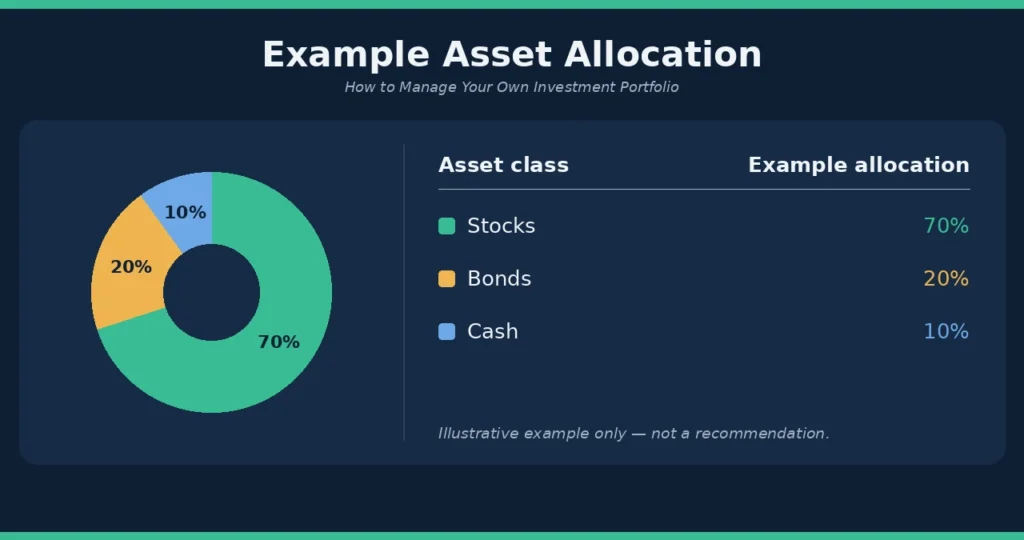
| Asset class | Example allocation |
|---|---|
| Stocks | 70% |
| Bonds | 20% |
| Cash | 10% |
That’s an example to illustrate the concept, not a recommendation. Usually, the younger investor with several decades left till they retire tends to invest heavily in stocks to accumulate wealth for when they retire, while the investor closer to their goal usually turns toward bonds and cash to protect their accumulated returns. The ideal mix of your asset allocation will of course depend on your own needs, the timing of those needs, and risk preferences. Investor.gov, an SEC site devoted to investor education, includes a good, neutral introduction to asset allocation and diversification.
If real estate ends up being one of your “other asset classes,” remember that protecting that investment property from damage is an ongoing cost of owning it, not a one-time one — factor it in alongside fund fees when you’re weighing the allocation.
Diversify And Check for Overlap
Diversifying means spreading risk across and within asset classes so one poorly performing sector or company can’t drag down the whole portfolio:
Across asset classes, don’t keep all eggs in one basket. For instance, don’t depend totally on stocks or an individual sector, such as technology.
We do this within an asset class too — for stocks. One should diversify and spread exposure across firms, sectors and geography.
While working with both client and my own portfolios, I’ve realized that investors tend to think that 3 or 4 funds mean automatic diversification, when they’re actually 70% to 100% overlapping. Two “different” ETFs can be packed with the same handful of big tech companies. Ignore the names and see what you own. The same applies to the number of holdings in a portfolio: 30 overlapping tech stocks can be more risky than 3 diversified funds; check FINRA resources for some perspective.
Monitor Without Obsessing, and Rebalance When Needed
- No advantage can be gained by daily monitoring of the portfolio — on the contrary, it is only likely to prove more stressful. A much simpler rhythm seems to be more beneficial:
- Monthly: make sure all contributions are processed and there are no unusual charges.
- Every few months: take a quick look at your total allocation and observe any build-up in one part.
- Review your portfolio at least once a year — check fees, diversification, goals, and whether you’re still on target.
- My experience with this was that a scheduled check-in beats daily watch-trading — it keeps you updated without giving you the temptation to trade out of bad-news-day impulses.
Using the example of one year, market movements would cause your target allocation to drift away from your preset values even without you buying or selling anything. For instance, suppose you start with a goal of 70/20/10, and after a bullish stock market, your portfolio has moved away from that goal to 80/14/6. Rebalancing your portfolio (selling some of the holdings that have gained relative to your goal and purchasing more of those that have fallen relative to your goal) brings your portfolio back toward your original 70/20/10 target. This should be done either at regular time intervals (i.e., every 6 months) or whenever your allocation drifts away from its target by a predetermined amount.
Watch Fees and Avoid Emotional Decisions
The effect of expense ratios, trading costs and advisory fees has a compounding effect over a period of decades. A 1% per annum fee doesn’t seem too much, but after 30 years it could meaningfully reduce your final balance compared to a lower-cost fund holding similar investments. Know the fees before you buy, rather than finding out after you’ve paid them.
Be on the lookout for emotional investing on the side: paying too much attention to last year’s winners, panicking to sell on a crash, or jumping in on the momentum of hype on social media. Designing a plan is important because it gives you set rules to follow at times like these, rather than trying to anticipate every twist of the market.
When Should Self-Management Be Considered?
The most straightforward approach, doing it yourself, provides direct control and can be less costly but does require research and discipline. An advisor removes some of that time element but introduces some cost along with professional advice. They will charge a fee, typically a percentage of assets under advisement. Neither one is necessarily best — you need to weigh how much time you are willing to invest and how comfortable you are with implementing the steps above.
My Quick-Start Portfolio Checklist
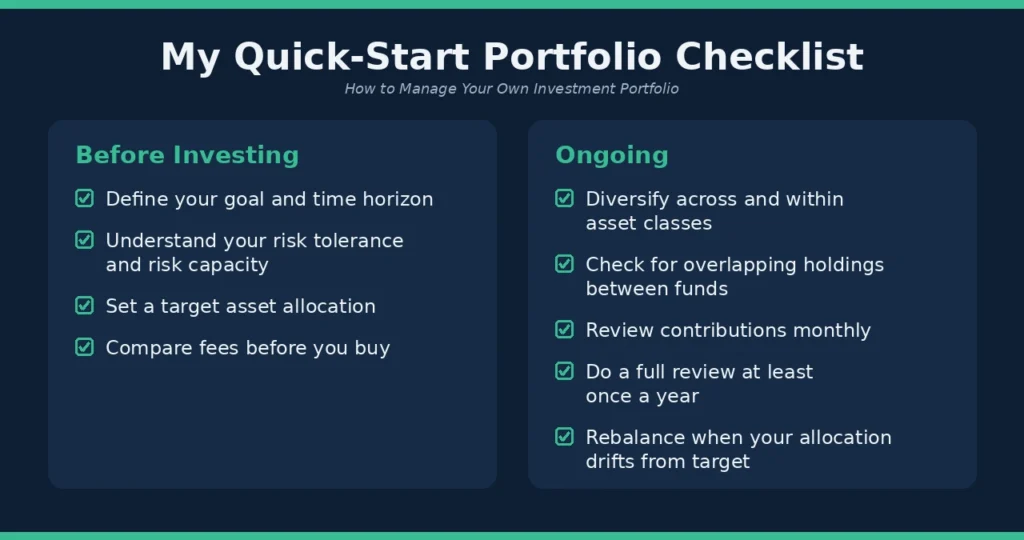
Before investing
- Define your goal and time horizon
- Understand your risk tolerance and risk capacity
- Set a target asset allocation
- Compare fees before you buy
Ongoing
- Diversify across and within asset classes
- Check for overlapping holdings between funds
- Review contributions monthly
- Do a full review at least once a year
- Rebalance when your allocation drifts from target
Frequently Asked Questions
How often should you review a portfolio?
Monthly for contributions and transaction activity, every 2–3 months for allocation, and at least once a year for fee structure, diversification, and goal setting.
What rebalancing frequency should you use?
There is no one best number. Calendar-based (every six or twelve months) and threshold-based (if your asset class drifts a certain percentage away from your target allocation) both work the same amount of time — choose one and be consistent.
Must you own loads of different investments in order to be diversified?
No. It is whether the contents of what you buy overlap that makes the difference, not how many you buy. Selecting several appropriate funds that do not overlap can give greater diversification than a dozen that do.
I always advise that you begin with a simple plan and tweak it along the way as your life and your objectives change. You don’t need an amazing plan on day one; you need an obtainable one.
This is for general educational purposes and not a personalized recommendation to buy, sell or hold any security or investment. Speak to a financial advisor and consider your own financial position, objectives and appetite for risk before investing.